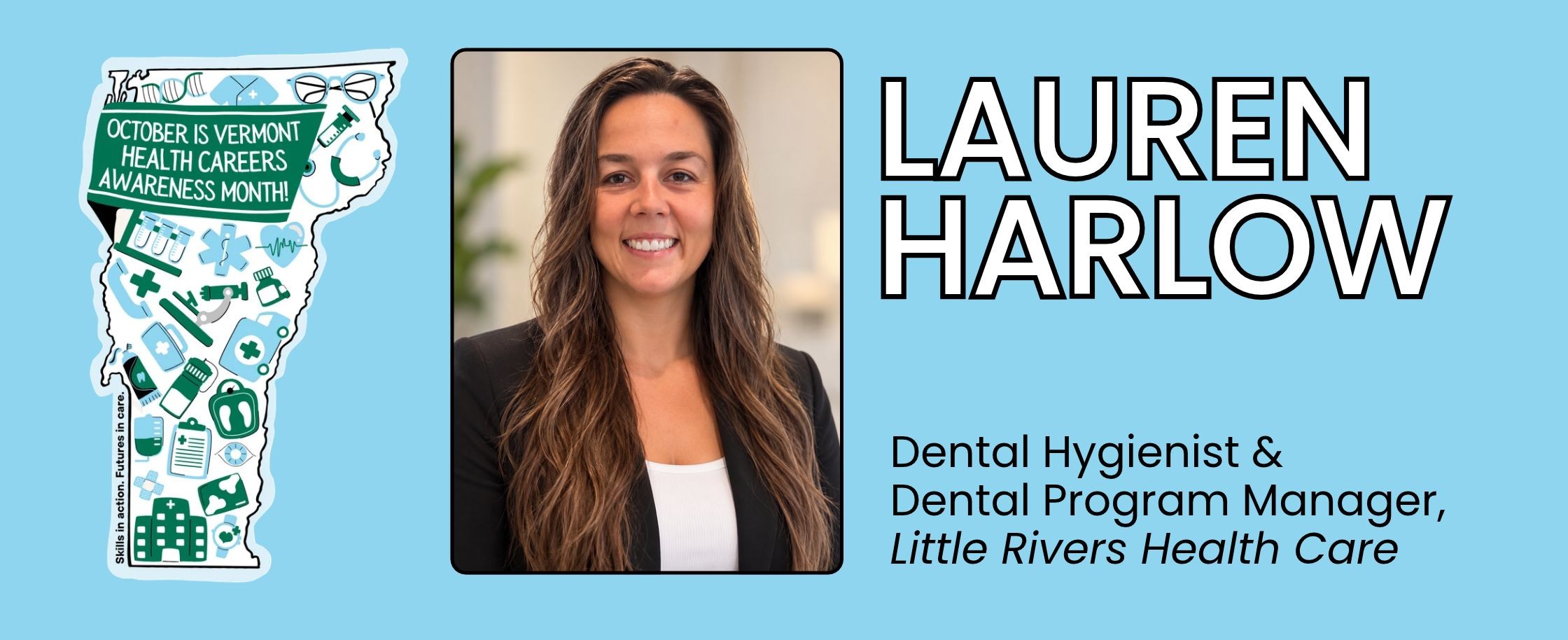
At a time when Vermont is struggling to meet the demand for dental care, Lauren Harlow’s path into dental hygiene offers a closer look at a career built around prevention, relationships and the kind of care that can change what happens next.
Lauren Harlow sometimes sees patients who have not been to a dentist in 30 years.
By the time they sit in her chair, some are embarrassed. Some are ashamed of how much time has passed. There may have been no nearby office taking patients, no insurance, insurance a practice would not accept, or simply no realistic way to afford or reach care.
Harlow knows that getting them through the door is only the beginning.
What stays with her are the patients who leave feeling differently than when they arrived – relieved, grateful, a little more hopeful about what comes next.
“After our appointment I’m able to make them feel better and help them move forward,” she says.
It is not necessarily the first image that comes to mind when someone hears dental hygienist. The profession is still often reduced to the familiar shorthand of a “cleaning,” something Harlow wishes people understood differently.
Because much of dental hygiene is about what happens before there is a bigger problem.
“Dental hygienists are the backbone of dentistry,” she says, describing a profession centered on preventive care, patient education and supporting the larger dental care team.
In Vermont, that work is also in increasingly short supply.
The state counted 553 dental hygienists actively practicing in Vermont in its 2023 workforce census, representing about 403 full-time-equivalent positions – essentially unchanged from 2021 and still below Vermont’s workforce capacity in 2017. Their distribution is uneven, too: Chittenden County had more than twice the hygienist capacity per capita of several rural counties.
The numbers have consequences. Vermont dental providers have described struggling for months or years to fill hygiene positions. In 2024, the UVM Medical Center’s dental practice reported scheduling hygiene appointments nine or 10 months out and had stopped accepting new patients. By late 2025, some Vermont providers were reporting waits longer than a year for routine care.
Harlow does not need the statistics to tell her there is a problem.
“There is and has been a significant shortage of dental professionals in VT, NH and around the country,” she says. “This makes it difficult for many people to access basic care.”
For her, that is precisely why prevention matters.
The Health Care That Happens Before Something Hurts
Harlow has spent 13 years working in dental hygiene in Vermont. Today, she is a Dental Hygienist and Dental Program Manager at Little Rivers Health Care in Newbury, a role that combines patient care with program development and community health work. She is also one of Northern Vermont AHEC’s newest board members.
On a clinical day, she typically sees about eight patients. On another day, she might be working on program development, coordinating with schools, attending meetings or handling the administrative side of Little Rivers’ dental work.
But the thread running through it all is prevention.
Dental hygienists examine patients for signs of oral disease, provide preventive treatment and help patients understand how to protect their oral health. The work requires clinical skill and precision, but also communication, critical thinking and an ability to make people comfortable in a setting that many find intimidating.
Harlow names organization, time management, flexibility, communication and empathy among the qualities that matter most in her field.
And she is quick to push back on the idea that oral health somehow sits apart from the rest of health care.
“Dental health is directly related to our overall health,” she says. “If we have an unhealthy mouth it leads to other health concerns in our body.”
That connection is one reason demand for preventive dental services is expected to continue growing nationally. The U.S. Bureau of Labor Statistics projects dental hygienist employment to grow 8% between 2025 and 2035, faster than the average for all occupations.
But Harlow describes the value of the work less clinically.
“I help people make better oral health choices and bring their mouth back to health as best I can every day.”
Her favorite part of the job is only three words.
“Talking with people.”
For a career built around instruments, X-rays, clinical knowledge and procedures, it is a revealing answer. Dental hygiene is also a relationship profession.
And in a small Vermont community, those relationships tend to matter.
Finding a Health Care Career That Fit
Harlow grew up in Vermont, and her path into dental hygiene began before college.
She knew in high school that she was interested in dentistry. She spent time shadowing in a local dental office and met hygienists who became mentors – people who could show her what the profession looked like beyond a job title.
She always knew she wanted health care. She also knew what did not feel right.
“I wanted a career in health care but nursing wasn’t appealing,” she says. “I wanted to have a good work/life balance and not years of schooling.”
Dental hygiene turned out to occupy a space she had been looking for: direct patient care, independence and relationships, with a more direct educational pathway than many other clinical health professions.
Harlow earned an Associate of Science in Dental Hygiene from Vermont Technical College in Williston, Vermont. Nationally, an associate degree is the typical entry-level education for the profession, followed by state licensure. The training is substantial: dental hygiene programs combine classroom, laboratory and clinical education in areas such as anatomy, microbiology, periodontics and patient care.
That shorter pathway should not be confused with an easy one.
Harlow remembers the program as demanding. She took some courses over summers and ahead of schedule to make the workload more manageable. What helped, she says, was having already spent time around the profession.
Her first health care job was as a dental assistant in a local practice, where she worked during summers and school vacations while in college. She credits that experience with giving her a head start once she entered her clinical training.
“Highly recommend doing this,” she advised. “It helped me so much.”
There are practical reasons the profession appealed to her, too. Harlow points to the flexibility that can come with dental hygiene, including daytime schedules and the possibility of strong work-life balance. She also notes that compensation can be competitive relative to the length of the educational pathway.
National data bear out some of that appeal: the median annual wage for dental hygienists was $98,100 in 2025, although actual pay and benefits vary significantly by location, employer and schedule, and many hygienists work part time.
For a student interested in health care but unsure that the most familiar pathways are right for them, that combination can make dental hygiene worth a closer look.
The problem, Harlow says, is that many students may never get that look.
Helping the Next Generation See the Possibility
When Harlow thinks about her own path now, there is one thing she wishes had been different.
“I wish it was talked about more in school, and that more educators were aware of it to present to students as well,” she says. “I felt like I had to figure it all out on my own.”
She did have opportunities that helped. She took a health science course at her local technical center, River Bend Career & Technical Center. She shadowed. She found mentors. She worked as a dental assistant. Each experience made the profession less abstract.
That matters when Vermont is trying to build a dental workforce large enough to meet the needs of its communities.
A student cannot consider a career they have never heard much about.
And dental hygiene is exactly the kind of profession that can get lost when “health careers” are reduced to a handful of the most visible roles. It is a licensed clinical profession with its own expertise and responsibilities. It offers direct patient care without requiring a four-year degree for entry. It can lead beyond the traditional dental office into public health, education, program management and other areas – something Harlow’s own career already demonstrates.
It is also a profession Vermont has a particular reason to make visible.
A 2024 examination of Vermont’s oral health system found significant gaps in access to dental care and documented a decline in the state’s dental workforce over the preceding years. Between 2015 and 2021, the number of practicing dental hygienists declined by about 4%.
More recent reports suggest the labor market remains extraordinarily tight. Nationally, the American Dental Association reported in 2026 that among dentists who were recruiting or had recently recruited a hygienist, 91% described the process as very or extremely challenging.
The result is not simply an empty position on an organizational chart.
When a practice cannot find a hygienist, fewer patients can receive routine preventive care. Appointments stretch farther apart. New patients may not be accepted. Dentists may take on hygiene work themselves, reducing the time they have for procedures that require a dentist. The effects ripple outward.
And eventually, a workforce shortage becomes an access-to-care problem.
The Value of Being Known
Harlow grew up in Vermont and wanted to stay here.
Thirteen years into her career, what she values about practicing in a smaller community sounds less like a professional perk than a reason for doing the work.
“It allows me to help my friends, family and neighbors,” she says. “People who work hard and deserve to have access to preventive care that’s located near them and by someone they can trust.”
She describes Vermont’s dental community as tight-knit, with professionals supporting one another. With patients, that closeness means seeing the same people again and again – not simply treating a problem and moving on, but building relationships over time.
There are harder parts of the work that patients may never see. Dental hygiene is physically repetitive and can be demanding on the body. Helping patients understand the importance of preventive care can also be difficult, particularly when they have spent years thinking of the dentist as somewhere to go only after something is wrong.
Yet prevention depends on precisely the opposite idea: that good care can change the trajectory before something hurts.
That is the work Harlow has built a career around.
And when asked what Vermont needs from the next generation, she does not talk only about filling her own profession.
“We need hygienists, dentists and assistants,” she says. “They are all equally as important to the field.”
For students who are curious, her advice is not to commit to a career based on a description online. It is to go see one. Talk to a dental hygienist. Spend a day shadowing. Ask a local office whether there are opportunities to work as an assistant. Look into programs and prerequisites early. And if dental hygiene is not the answer, do the same thing with another health profession.
“I would strongly encourage you to reach out to a local facility or someone and do some shadowing/discussions,” Harlow says. “No matter what the field!”
It is fitting advice from someone who found her own career because she was given the chance to get close enough to see it.
Harlow once wished dental hygiene had been talked about more when she was a student. Now she is a clinician, program leader and Northern Vermont AHEC board member in a state that badly needs more people to understand what dental professionals make possible.
Perhaps that is the most useful way to tell the story of a career shortage: not simply to count the people who are missing, but to show students who are already doing the work – what brought them there, what keeps them there and what could be waiting for someone willing to take a closer look.
For Harlow, at least, the answer after 13 years is clear.
“The hard work, dedication, and schooling was worth it.”
To learn more about careers in Dental Health: https://vthealthcareers.org/careers/dental-health/