He didn’t recognize the person. There was no reason he should have. They had crossed paths only briefly, during one of the most difficult moments in that person’s family.
The stranger explained that Weeden had cared for their ailing parent in the hospital. Imaging had been ordered after the patient complained of significant pain, and Weeden arrived at the bedside with a portable X-ray unit. The examination normally called for the patient to sit upright. They couldn’t. So Weeden stopped.
He talked with the patient, listened as they explained where the pain was coming from and found another way to get the image without causing unnecessary discomfort.
Later, the patient’s spouse told him that he had been one of the few people who made their loved one feel genuinely cared for in their final days.
Now, standing in a grocery store, they had recognized him and wanted him to know.
The encounter stayed with Weeden.
“You never know who is watching, how someone interprets your actions,” he reflected.
It is a story about radiography that has very little to do with pressing a button. And that is precisely the point.
More than taking an X-ray
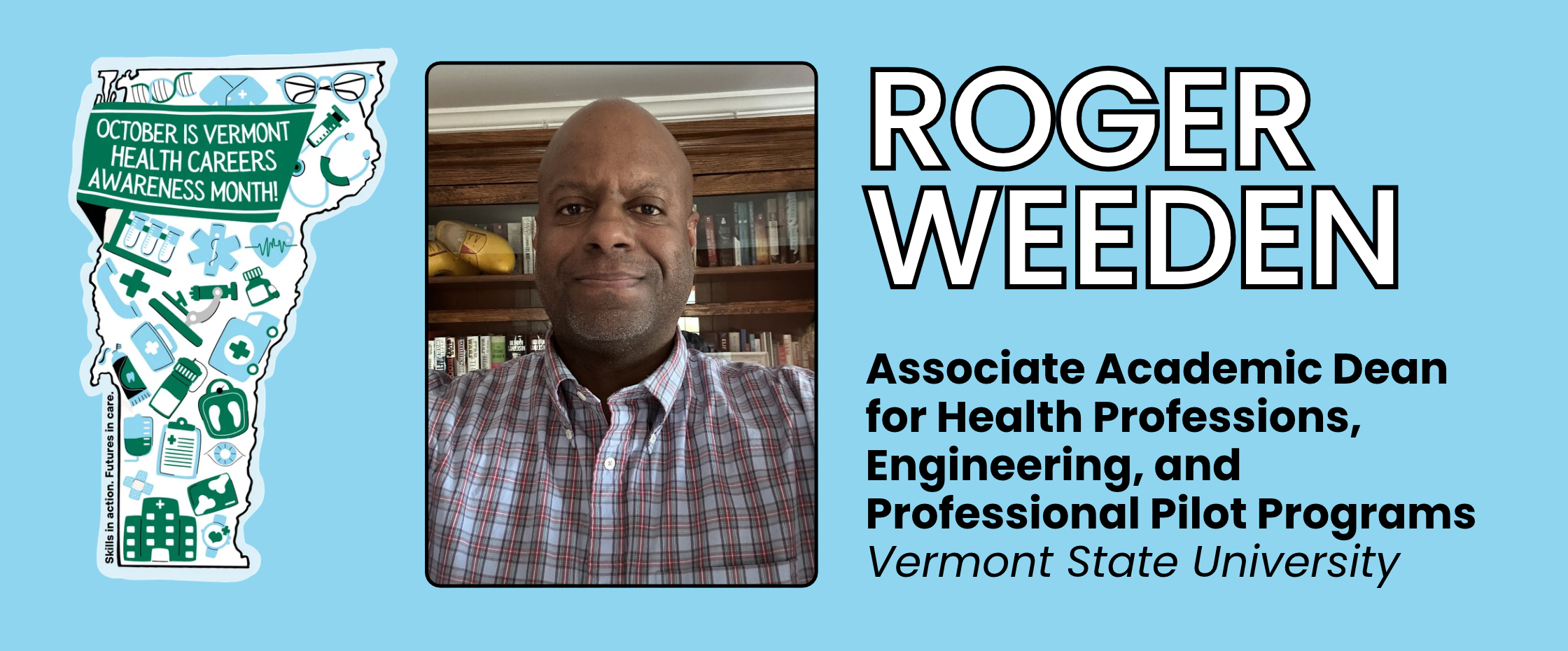
Weeden has spent 28 years as a radiographer and 24 years working in radiologic education, with much of that time overlapping. He has practiced in Vermont for 25 years and today serves as Associate Academic Dean for Health Professions, Engineering, and Professional Pilot Programs at Vermont State University.
His description of radiography is deceptively simple.
Think of photography, he says. The camera is an X-ray tube. The subject is anatomy. The photo, the radiograph, gives health care providers a view of what cannot be seen from the outside.
But creating that image requires considerably more than pointing a machine and pushing a button.
Radiologic technologists use knowledge of anatomy, positioning, physics, radiation safety, and imaging technology to produce diagnostic images while limiting a patient’s radiation exposure. Those images may reveal a fracture, help identify disease, guide treatment or give the rest of the health care team information it cannot get any other way.
As Weeden puts it, radiography is often “the necessary link” that helps other health professionals make a diagnosis, understand prognosis, and determine treatment.
A patient comes into an emergency department after a fall. Someone develops unexplained chest pain. A physician needs to know whether an injury is healing properly. A team is trying to determine what is causing pain that cannot be explained from the outside.
Before many of those questions can be answered, someone has to create the image.
“Radiography and all areas within Radiology offer literal insight to patient condition,” Weeden said. “The ability to assess internally can be critical for planning care.”
A profession Vermont cannot afford to overlook
That work is especially important in Vermont, where radiologic technologists are among the health care professionals employers are struggling to find.
2026 Vermont health care workforce strategy identified radiologic technologists as one of the state’s highest-priority associate-degree health care careers. Employers are already struggling to fill open positions, and the number of new graduates entering the field is not keeping pace with the need. That gap is expected to continue as Vermont works to maintain imaging services across hospitals and other health care settings.
State workforce data add to that picture. Most of Vermont’s radiologic technologists work in hospitals, where imaging is woven into everything from emergency care to cancer treatment, surgery, and routine diagnosis. And with part of the existing workforce approaching retirement age, bringing more people into the profession is not simply about filling today’s vacancies – it is about making sure Vermont has enough trained professionals for the years ahead.
Those realities make career awareness especially important. Radiography is a skilled, accessible pathway into health care that many students may never have considered – much like Weeden himself when he was deciding what came next after high school.
The workforce is not evenly distributed, either. The state found significant differences in radiologic technologist capacity from county to county, underscoring a familiar challenge for rural health care: having a service available somewhere in Vermont is not necessarily the same thing as having it available where a patient needs it.
And imaging is not a peripheral service.
“Radiography matters due to its ability to provide essential, non-invasive images of anatomical structures,” Weeden said, allowing clinicians to detect, diagnose, and guide treatment for conditions “ranging from fractures to cancer.”
Without enough people trained to perform that work, one piece of the larger health care system becomes harder to deliver.
Weeden describes health care as an “ecosystem,” made up of many clinical and non-clinical professions. Radiography is one of those careers that may not always be visible to students looking from the outside, but inside a hospital, its reach is difficult to miss.
The career he didn’t know existed
There is something particularly meaningful about Weeden now helping educate the next generation of health professionals. After all, he knows firsthand that finding the right career path doesn’t always begin with knowing exactly where you want to go.
When he graduated from high school, radiography wasn’t a profession he had considered. In fact, it wasn’t on his radar at all.
Weeden earned a Bachelor of Arts in English and thought he might pursue law. He graduated at a moment when print publishing was beginning its shift toward digital, worked a collection of jobs and eventually found himself encountering the health care system as a patient.
That experience introduced him to a profession he had never really considered.
He started researching.
Eventually, he found a radiography program. Two years later, in 1998, he completed his training and began working in the field. His first health care job was on third shift as a radiographer at Valley Regional Hospital in Claremont, New Hampshire.
His path continued from there.
Weeden kept building on his education and, in 2002, became director of a hospital-based radiography program. That move began the educational career that eventually brought him to his current role at Vermont State University.
Looking back, Weeden wishes he had understood earlier that a rewarding, well-paying career in health care didn’t necessarily require four years of college or significant student debt.
With a two-year associate degree, he could have entered the radiography profession and continued building his education and career from there.
That doesn’t mean he regrets the path he took. Quite the opposite. After nearly three decades in radiography and more than two decades in education, Weeden finds fulfillment in helping others discover opportunities he didn’t know existed when he was younger.
“Knowing now what I did not know then may help others,” he reflected.
That is not just hindsight. It is an important piece of career information for students now.
An associate degree is the most common educational level among Vermont’s current radiological technologists: 54% reported an associate degree as their highest credential related to their license.
A recent Vermont workforce analysis reported average pay for radiology technologists at $39.42 per hour in 2024. Nationally, the U.S. Bureau of Labor Statistics reported a median annual wage of $80,110 for radiologic technologists and technicians in 2025 and projects employment in radiologic and MRI technology to grow 5% through 2035.
For the right student, then, radiography can offer something that is not always obvious when health care careers are discussed: a comparatively direct route into a licensed, skilled profession with strong earning potential, significant responsibility, and room to grow.
It’s an opportunity Weeden believes more students should know about as they begin exploring their futures.
Art, science – and responsibility
There is another misconception Weeden would like to dismantle.
“It is not as simple as pressing a button.”
Radiographers are responsible for working with ionizing radiation, and their education prepares them to use it safely and intentionally. They must understand how to obtain an image that is useful enough for diagnosis while minimizing unnecessary radiation exposure.
The radiologic technologist creates the image and the radiologist, a physician, interprets it and issues the diagnostic report. Experienced technologists may recognize what they are seeing, Weeden explains, but their role is different from that of the physician who formally interprets the study.
It is work grounded in science, but Weeden also describes radiography as a blend of art and science.
The physics can intimidate students at first, he acknowledges. But many of its concepts can be broken into pieces and connected to things people already understand. Slowly, the terminology, mathematics, and technical knowledge build on that foundation.
Then there is the other half of the job: the person standing, sitting or lying in front of the machine.
Excellent communication is essential, Weeden says, and it has to change depending on who the patient is and what they need. So do critical thinking and empathy – the ability, as he describes it, to put yourself in someone else’s shoes.
The patient may be a frightened child. Someone in severe pain. Someone who cannot move the way a textbook says they should. Someone receiving some of the worst news of their life. The image still has to be taken – but how it is taken matters, too.
One career, many directions
Radiography can also be a starting point rather than an endpoint.
After becoming a registered radiologic technologist, professionals can pursue additional clinical experience and education in areas such as computed tomography (CT), MRI, mammography, interventional radiology, and cardiac catheterization.
“There are many aspects of radiography and further career paths,” Weeden explained, encouraging students to research the profession and explore the opportunities available to them.
That range is already visible in Vermont’s workforce. General radiography is the most common specialty among the state’s radiological technologists, followed by computed tomography, and many technologists hold additional credentials beyond their primary certification.
It is one reason Weeden says one of his favorite things about the profession is that “you seldom do the same thing in one day.”
A typical clinical day starts well before the first image. Equipment has to be checked for safe operation and warmed up. Supplies need to be stocked. The examination schedule may be reviewed. Then the work begins – with each patient bringing a different body, circumstance, concern, and clinical question.
There can also be heartbreak.
When asked about a challenge people outside the profession may not see, Weeden offered a poignant reminder of the emotional weight that can come with caring for patients: “There can be heart break for the loss of someone.”
It is another reminder that the work takes place at the intersection of technology and real human lives.
In Vermont, the community comes with you
Weeden did not grow up in Vermont. He came here after meeting someone from the state while living and studying in North Carolina. He has now practiced here for a quarter century.
One thing about Vermont health care became apparent to him quickly: the distance between “provider” and “community member” can be very small. You may care for someone in a hospital and see them later at the grocery store. You may know their family. They may know yours.
For Weeden, that closeness is a reminder of both responsibility and privilege.
“It is a strong reminder that we do care for our community,” he said, and a reminder to treat everyone with dignity and respect.
Asked what he finds meaningful about working in Vermont, his answer is just as direct:
“You feel like you matter, you have an impact for the positive.”
That sense of impact is something he hopes another generation of health professionals will find here, too.
Get close enough to see it
Weeden’s advice to students begins with something practical: go into a hospital and look around.
Volunteer. Observe. Pay attention not just to the professions everyone already knows, but to the ecosystem around them.
“Observe the professionals in a hospital or clinic,” he advises. “Get a sense of the work environment, the act of examining a patient, and see yourself in the role.”
For high school students, he points to dual-enrollment courses such as English composition, psychology, sociology, algebra or health-related math, and medical terminology as useful building blocks.
The larger lesson from his own path may be simpler: ask more questions. Research careers you have never heard much about. Spend time around people doing the work. Do not assume that wanting to work in health care automatically means becoming a doctor or a nurse.
There are careers happening throughout a hospital that a patient may encounter for only a few minutes but that can change what clinicians know, what happens next, and how that patient experiences one of the hardest days of their life.
For Weeden, discovering radiography came through his own experience with health care. It was not the path he originally envisioned, but it became a profession that would shape nearly three decades of his life.
Today, as an educator, he has an opportunity to help others recognize possibilities they might otherwise overlook.
His advice to his younger self is the same advice he now offers students:
“Research career fields and ask more questions about them.”
In a state that needs more radiologic technologists, making the career easier to see is not simply career exploration.
It is part of building the health care workforce Vermont will depend on next.
Resources:
U.S. Bureau of Labor Statistics: Radiologic and MRI Technologists
Health Care Workforce Census: Radiological Technologists, 2023
Outcomes and Recommendations of the Healthcare Leaders Workforce Summit
Vermont Talent Pipeline Management: Healthcare Workforce Reports