
Heidi Richard’s career has taken her from nursing assistant to registered nurse to teacher. At a moment when Vermont needs more nurses, she is both doing the work and helping another generation imagine themselves in it.
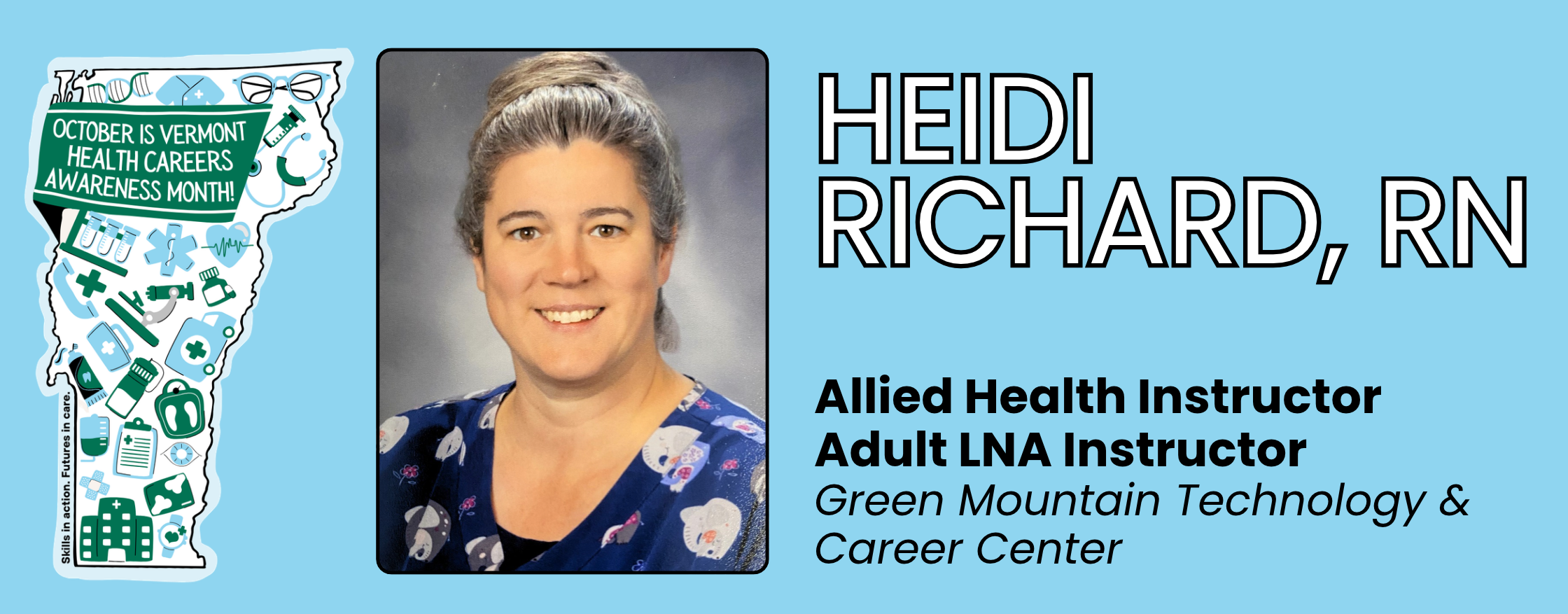
Heidi Richard gets to see two kinds of progress.
At The Manor in Morrisville, where she works as a registered nurse (RN), it can look like a resident smiling, maintaining independence or holding on to a quality of life that matters to them.
At Green Mountain Technology and Career Center in Hyde Park, it looks different. There, Richard watches students who once stood hesitantly on the sidelines begin providing patient care with confidence.
Both are among her favorite parts of the job. And together, they tell a larger story about nursing in Vermont: caring for the people who need nurses today while making sure there are enough people ready to do the work tomorrow.
Richard has spent 28 years working in healthcare in Vermont, including a decade as a Licensed Nursing Assistant (LNA), 10 years as an RN and eight years teaching. Her current work spans both clinical care and education.
It gives her a broad view of a profession she describes as both an art and a science.
“Nursing is the art and science of caring for people when they are sick, injured, or vulnerable, while also helping them stay healthy,” she described. It is high-level medical care, she added, but also compassion: monitoring, treating, advocating and supporting “the whole person” through illness, recovery and wellness. That combination has always been central to nursing.
In Vermont, it has also become increasingly difficult to have enough people to provide it.
A familiar profession with an unfamiliar scale of need
There may be no health career more immediately recognizable than nursing. What is less visible is the scale of Vermont’s need for nurses or the range of places nurses are needed.
In the state’s 2024–26 employer-led nursing workforce assessment, participating healthcare employers projected a need to hire more than 1,200 registered nurses each year. Vermont’s nursing programs, meanwhile, produce roughly 400 graduates annually. New graduates are only one part of Vermont’s nursing workforce equation. Still, the difference between employer demand and the number of new nurses entering the field shows how much pressure the pipeline is under.
There is another challenge ahead. In Vermont’s most recent RN workforce census, one in five active registered nurses was already 60 or older.
The need for nurses is both statewide and widespread across the healthcare system. From rural communities to larger population centers, nurses are needed in acute care, primary care, schools, home health, community settings and long-term care.
Richard has worked across several of those settings, giving her a broad view of the profession. Among those settings, Richard believes long-term care deserves more attention.
Rethinking long-term care
Richard works with older adults at The Manor, a nonprofit long-term and skilled nursing facility in Morrisville. Her description of the work pushes back on an assumption that geriatric nursing is somehow less clinical than other areas of the profession.
“Many people assume geriatric nursing is boring and not clinical or critical,” she said. “But that is simply not true.”
In a hospital setting, Richard noted, a nurse might be responsible for five patients. In long-term care, she may be balancing the needs of 20 residents.
Those needs do not become less complex because someone is older or because their care is happening outside a hospital.
Nurses administer medications and treatments, monitor changes in a patient’s condition, use medical technology, respond to emergencies and teach patients and families how to manage illness and prevent future health problems. In long-term care, Richard says, the work also demands seeing beyond an individual diagnosis.
“You need to treat the whole patient, not just an illness.”
That may mean managing chronic illnesses alongside mobility changes, medications, cognition, recovery from an acute event and the ordinary realities of aging – all while knowing the person behind the chart.
Richard identifies empathy, compassion, critical thinking, communication, listening, attention to detail, emotional resilience and adaptability as essential nursing skills.
There is also something harder to quantify: continuity.
In long-term care, a nurse may know a resident not for the length of a hospital stay, but across months or years. They know the family. They notice subtle changes. They understand what “doing well” looks like for that particular person.
For Richard, that relationship is not separate from the clinical work. It is part of it.
A pathway built one step at a time
Richard did not begin as an RN. Her first foothold in healthcare was not clinical at all: she worked as a hospital registrar and in office roles. But being inside the hospital made her want to get closer to patients.
So she became an LNA.
“I started work as LNA because I was working in a hospital and wanted more hands-on experiences with patients,” she said.
The LNA class itself became an important influence on the direction she took next.
Richard went on to become a registered nurse, with experience that has included nursing, school nursing and LNA instruction. She became an advocate for LNAs and for the importance of the work they do. Eventually, she realized she was just as passionate about teaching people to care for patients as she was about providing the care herself.
Her pathway is also a useful reminder that nursing does not have a single entrance.
Registered nurses can enter the profession through several educational routes, including associate and bachelor’s degree nursing programs, before meeting licensing requirements. From there, nurses can move into specialties, pursue additional education or build careers in areas ranging from direct patient care to education, leadership and advanced practice.
For someone still exploring the field, nursing can begin even earlier.
Richard recommends LNA or personal care attendant (PCA) training as a way to gain exposure and practical experience, particularly through Vermont’s career and technical education programs. At GMTCC, she now teaches an LNA course that combines classroom learning with hands-on nursing skills and prepares students for state licensure testing.
It is the kind of opportunity she wishes she had recognized sooner. But her own route also gives her perspective she can now offer students: careers do not always unfold in a straight line, and the first step does not have to be the last one.
The nurse- and the person teaching the next one
As an RN, Richard describes herself as a liaison between patients, families and physicians.
As a teacher, she sees another responsibility.
“I am grooming the next generation to be prepared for college and career after graduation,” she said.
That role takes on added weight when Vermont is already struggling to meet nursing demand.
Richard sees students before they are nurses – or sometimes before they are even sure healthcare is for them. She gets to watch confidence develop alongside technical skill.
Her favorite moments include “watching my students grow from timid students watching on the sidelines to providing confident care and improving patient outcomes alongside me.”
Richard gets to see what can happen once a student has been given the chance to step into the work. The larger challenge is making sure more young people get that chance in the first place – because before recruitment, comes exposure.
A student needs a chance to see the work, try a skill, meet someone doing the job and begin to imagine themselves there. That may happen in a classroom, through a technical education program, during a clinical experience or simply through an encounter with someone willing to show them what the profession actually looks like.
Richard now provides that kind of early window into nursing while also preparing students who may eventually become part of Vermont’s healthcare workforce.
And the workforce challenge is not only about bringing new nurses into the profession. Vermont employers are also confronting the realities of retaining the nurses already doing the work. Richard identifies short staffing and long hours among the challenges people outside nursing may not always see.
Those pressures matter because nursing shortages do not stay confined to staffing spreadsheets.
Fewer nurses can mean heavier workloads for the people who remain, fewer people available to provide care and more strain on a system already trying to meet growing needs.
A career with many directions
One thing Richard thinks might surprise a student is simply how expansive nursing can be.
“You can work with humans from before they are born all the way up to the end of life,” she said. “It is very flexible and you can always learn something new.”
A nurse can work with newborns or older adults. In an operating room or a school. At a bedside, in a community or eventually in a classroom.
That flexibility also works in Vermont’s favor. Vermont has participated in the Nurse Licensure Compact since 2022, which allows eligible nurses who hold a multistate license in another compact state to practice in Vermont without obtaining a separate Vermont license. For a state working to strengthen its nursing workforce, that can make it easier for qualified nurses to step into needed roles here.
National demand remains strong as well. The U.S. Bureau of Labor Statistics projects RN employment to grow faster than the overall labor market through 2035, with hundreds of thousands of openings expected nationally each year as the workforce grows, and nurses retire or leave the profession.
But Richard’s advice to someone starting out is less about choosing the perfect specialty and more about building a foundation.
“Keep an open mind to all areas of healthcare,” she said. “Know you will have to start small and build solid skills before you can work up to specialty clinics.”
In other words: learn the work first, and see where it takes you.
Caring close to home
Richard is from Vermont. After time away while her husband served in the military, the couple returned home. She knows the differences between rural and urban healthcare, but her own work has become firmly connected to a small Vermont community.
“I am very closely connected to my patients and families in the community,” she said. Teaching has deepened those connections even further.
It means that the people she cares for are rarely abstract. They are neighbors, familiar faces and families she may encounter again outside of work. Someone she cared for – or a student she taught – may recognize her in town and stop to say thank you.
Richard names those encounters as some of the moments that remind her that her work matters.
The impact works in both directions.
She finds meaning in knowing she is helping members of her own community stay healthy. At the same time, she is trying to show students that their own futures can extend beyond what they already know – to college, careers and experiences outside the county where they grew up.
She wants some of them to come back, too.
When asked what Vermont needs from the next generation of nurses, Richard points not only to more people, but to what those people can bring with them: new best practices, new technology and new ideas for delivering care in rural communities.
The future of Vermont nursing is not simply about replacing one retiring nurse with one new graduate. It is about preparing nurses who can carry forward what works, adapt to what changes and understand the communities they serve.
Start somewhere
Richard’s advice to a student considering nursing is practical.
Explore career and technical education. Take an LNA or PCA course. Get close enough to healthcare to find out whether you like being there. And do not assume you need the entire career mapped out before you begin.
Her own career grew one step at a time: hospital office work, LNA, registered nurse, school nursing, instructor. Each role changed what she could do for a patient. Teaching changed the scale again.
Now, Richard is helping students build the confidence and skills to see themselves in healthcare — and potentially become part of the workforce Vermont will need in the years ahead.
Vermont needs nurses. It needs people willing to care for older residents, work in rural communities, learn new technology, support families through difficult moments and take on the long hours and responsibility the profession can demand. It also needs experienced nurses willing to turn around and show someone else how to begin.
When Richard was asked why her work matters, she answered with the future in mind:
“My work matters because we need more youth who are passionate about our state in healthcare.”
And the advice she would give her younger self after all these years?
Just two words: “Be confident.”
For the students now standing where she once stood, it is not a bad place to start.
To learn more about a career in nursing, visit https://vthealthcareers.org/careers/nursing/
Sources:
- Vermont Talent Pipeline Management, 2024–2026 Nursing Needs Assessment: Healthcare Workforce Report
- Vermont Department of Health, Registered Nurses 2023 Workforce Census
- U.S. Bureau of Labor Statistics, Registered Nurses
- Vermont Office of Professional Regulation: Vermont’s participation in the Nurse Licensure Compact