
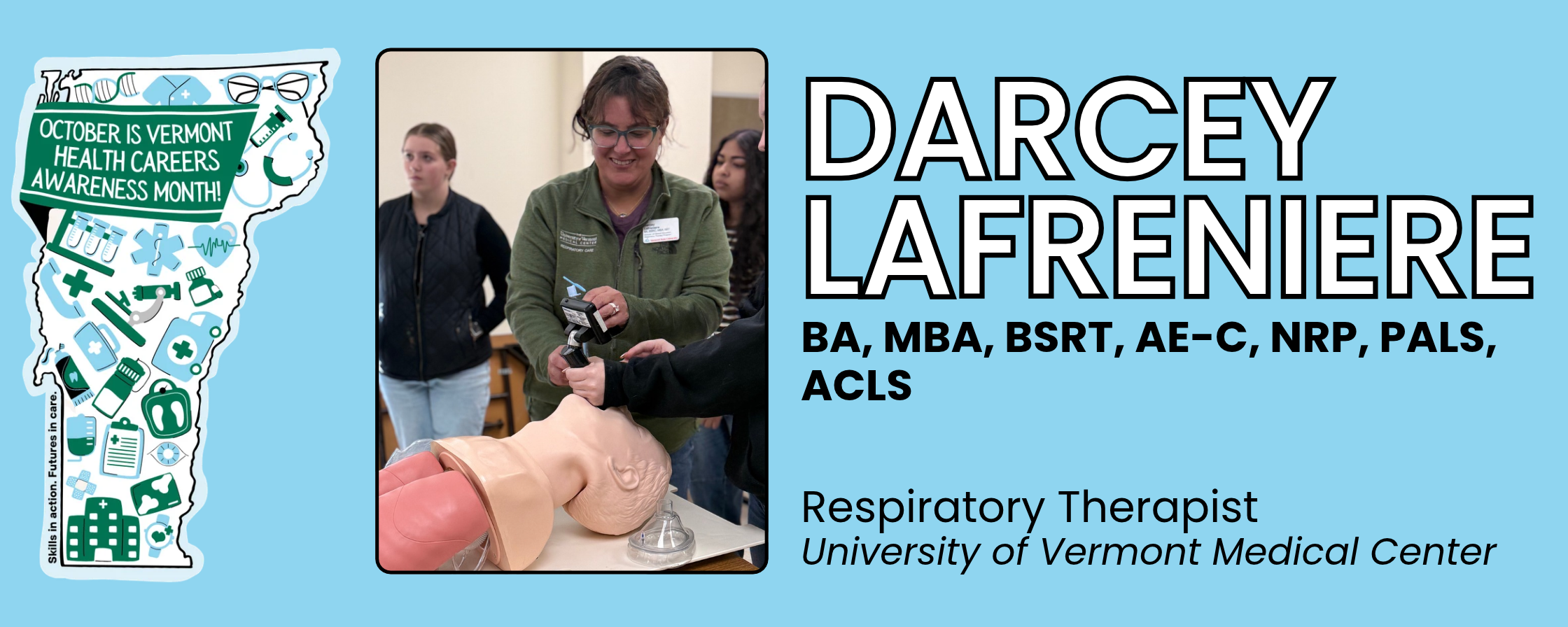
Respiratory therapists are there for first breaths, medical emergencies and the long work of helping patients breathe on their own again. Vermont needs more of them. Darcey Lafreniere spent years not knowing the career existed
She thinks about the premature baby whose lungs are not quite ready to do the work on their own. The patient in intensive care who needs a ventilator to stay alive. The person living with chronic lung disease who needs to understand how to manage it well enough to stay home, stay independent and breathe a little easier.
She thinks about breathing because, for the past 13 years, it has been her job.
“Breathing is something people don’t often think about until they can’t do it on their own,” Lafreniere said. “I am happy to be part of the care team that can help some breathe easier.”
Lafreniere is a respiratory therapist at the University of Vermont Medical Center in Burlington. Her profession reaches patients at virtually every stage of life, from infants to older adults, and across settings that include hospitals, clinics, sleep labs and home care. Respiratory therapists administer breathing treatments and oxygen, manage ventilators and other life-support equipment, perform diagnostic testing and help people understand chronic lung conditions.
But Lafreniere has an even simpler way of explaining where you will find them in a hospital.
“Respiratory Therapists are at every emergency.”
It is a profession with enormous responsibility – and one Vermont does not have enough people entering.
When breathing becomes the emergency
A respiratory therapist’s work can span the distance between a patient’s first breath and some of the most difficult moments of a person’s life.
An RT might help a premature baby breathe, stabilize someone during a medical emergency or operate the equipment keeping a critically ill patient alive. The same profession also works farther from the crisis, helping people with chronic lung conditions understand their disease and live more independently.
The scope is one of the things Lafreniere thinks people misunderstand.
“Many people think that we just give breathing treatments, but we are so much more than this,” she said. “We help take care of the most critically ill patients in the hospital.”
Her own days show just how much can fit inside that sentence.
She might begin a shift by receiving a report from the team before her. Depending on her assignment, she could be working in an intensive care unit, emergency department or elsewhere in the hospital. In the ICU, she rounds alongside nurses and physicians as the team determines a plan for each patient. As a charge therapist, she is also keeping track of other RTs and making sure assignments and staffing needs are covered.
Then the day can change.
She may need to move a critically ill patient on a ventilator to another part of the hospital for testing. An RT may head out with a HealthNet transport crew to bring a sick infant from another hospital to UVMMC. A stroke alert may be called. A patient may go into cardiac arrest.
The common denominator is that when breathing becomes part of the emergency, the respiratory therapist is there.
“Our day varies from hour to hour,” Lafreniere said. What remains constant, she added, is providing high-quality, patient-focused care regardless of the assignment.
That work requires a particular combination of skills. Respiratory therapists have to think critically and communicate with patients, families and other members of the medical team. They need compassion and empathy because, as Lafreniere puts it, they are often present during “the worst days of patients and families’ lives.”
And they have to stay calm.
“When it comes to a patient breathing, it is life or death,” she said, “and everyone is looking at you to try and fix the issue.”
A shortage hiding in plain sight
For all the places respiratory therapists appear in healthcare, the career itself can remain surprisingly invisible outside of it.
That is particularly consequential in Vermont.
A statewide assessment of healthcare technician occupations found a 29% vacancy rate among respiratory therapists – meaning nearly one in three positions included in the assessment was unfilled. Hospitals described positions remaining open for long periods and difficulty replacing one vacancy before another appeared. Vermont’s 2026 healthcare workforce strategy consequently identified respiratory therapy as one of the state’s priority associate-degree professions.
The state’s workforce itself is relatively small. The Vermont Department of Health’s most recent respiratory therapist census found 268 RTs actively practicing in Vermont. The report also found fewer full-time-equivalent RTs working in the state in 2022 than there had been in 2018.
At UVMMC, where Lafreniere practices, the shortage has been especially visible. In 2025, hospital leaders reported more than 20 vacant respiratory therapist positions and reliance on traveling RTs to help fill staffing gaps.
The problem is not simply that there are open jobs.
Respiratory therapists staff intensive care units, emergency departments and neonatal care. They manage ventilators. They respond to emergencies. They help care for people with conditions such as asthma and chronic obstructive pulmonary disease. When there are not enough of them, there are fewer specialists available to do work that cannot simply disappear because the position is vacant. And the demand is expected to grow.
The U.S. Bureau of Labor Statistics projects respiratory therapy employment to grow much faster than the overall job market through 2035, in part because an aging population is expected to increase the prevalence of conditions such as pneumonia and COPD.
Lafreniere sees the same future from Vermont.
“We need RTs,” she said. As Vermont’s population ages, she expects the need for respiratory therapists’ specialized skills – including helping people understand and manage chronic lung conditions – to continue growing.
The challenge is getting more people to see the career in the first place. Lafreniere knows something about that. She almost missed it herself.
The career she wasn’t looking for
Respiratory therapy was not Lafreniere’s original plan. In fact, healthcare was not her first career.
She had worked in an office for more than a decade when she decided she wanted to make a change. She thought nursing was probably the answer and applied to what was then Vermont Technical College.
She was waitlisted for nursing because she already had a degree. Then someone offered her a seat in respiratory therapy. There was just one problem.
“I had no idea what they did,” she said.
So she went to UVMMC and shadowed. The experience changed the direction of her life.
“I fell in love,” Lafreniere said. “The RTs were so eager to show me around and were so proud of the work that they did. I had no idea how specialized the role was.”
The people she shadowed made the profession visible in a way a program description could not. Their knowledge – and their obvious pride in what they did – helped convince her that this was where she belonged.
“Had they not been so knowledgeable and willing to share their passion, I may have not decided to join the program,” she said.
Before starting her respiratory therapy education, Lafreniere became a Licensed Nursing Assistant so she could work in a hospital and gain patient-care experience while studying. She went on to earn an associate degree in respiratory therapy through Vermont Tech’s five-semester program in Williston and later earned a bachelor’s degree in respiratory care. Her education and credentials now extend well beyond where she began, including a BA, MBA and advanced clinical certifications.
For all the education and experience that followed, Lafreniere’s path still leaves her thinking about how much earlier the profession might have entered the picture.
“I wish I had known what an RT was during HS or thought about the medical field sooner.”
That makes her story particularly relevant to Vermont’s workforce shortage. The state is trying to recruit more people into a profession many students may never have been taught to consider.
A direct pathway into specialized care
Respiratory therapy does not require the many years of graduate or professional education associated with some clinical careers.
Nationally, respiratory therapists typically enter the profession with an associate degree and must meet state licensing requirements. Their training combines anatomy and physiology with respiratory care, cardiopulmonary disease, pharmacology, diagnostic procedures and hands-on clinical experience.
In Vermont, Vermont State University offers the state’s respiratory therapy associate-degree pathway in Williston. The program combines classroom instruction with clinical experience and prepares graduates for national credentialing exams. VTSU describes the program as the state’s exclusive pathway to becoming a licensed respiratory therapist.
The pipeline is especially important because it is small.
Vermont’s 2024–26 workforce assessment found that the respiratory therapy program had capacity for more students than were enrolling, even as hospitals were reporting substantial vacancies.
That disconnect has prompted employers and educators to work together. Since 2023, UVM Health Network and Vermont State University have partnered to support Vermont’s respiratory therapy training program, including tuition assistance, operational support and a pathway for current health system employees to pursue the degree while continuing to earn wages and benefits. UVM Health describes the VTSU program as the state’s only educational pipeline for training respiratory therapists.
The gap, then, begins before the first day on the job: Vermont has employers who need respiratory therapists and a program with room to train more of them, but not enough people are entering the pipeline.
For Lafreniere, shadowing was the bridge between those two worlds. It is why she recommends it so emphatically now.
The people behind the equipment
Respiratory therapy is highly technical work. But ask Lafreniere what stays with her after 13 years and she does not talk first about ventilators or diagnostic equipment.
She talks about patients.
One in particular had been critically ill enough that Lafreniere did not think they would ever walk again. Later, that patient came back to visit the ICU – walking.
Those are the outcomes that make the hardest days worth it.
Her favorite part of the job is seeing patients discharged after what may have been some of the worst days of their lives. The most rewarding part is helping them through those days – helping them breathe – and seeing them make it home.
Not every story ends that way.
One part of the work people may not see, Lafreniere said, is the grief respiratory therapists carry alongside families when a patient is dying.
That proximity to life-and-death moments is part of what makes empathy so essential to the profession. An RT can be the person adjusting life-support equipment in one room and, later in the same shift, teaching someone in another how to manage a chronic condition so they can remain independent at home.
The technical and human parts of the work are not separate. They are the job.
Taking care of the people next door
Lafreniere has lived in Vermont her entire life, and after 13 years practicing here, community is still one of the reasons she stays.
“We are a small community, and I feel like we really get to know our patients,” she said. “I love knowing that I am taking care of folks in my community.”
Sometimes that closeness becomes literal. She cares for people she knows, or their relatives.
“It creates a strong sense of responsibility because they are not just my patients but my neighbors and members of my community.”
She could practice respiratory therapy somewhere else. What keeps her here is precisely the smallness that can make Vermont’s workforce challenges so difficult.
“I can be an RT anywhere in the world,” she said, “but I love community so being in Vermont is important to me.”
Her description of what that means is characteristic of the profession itself: straightforward, practical and tied to the thing most of us take for granted.
“I am doing meaningful work to help ensure my community breathes easier!”
You do not have to know yet
There is a temptation, especially when talking with high school students about careers, to make the path sound linear. Choose the right classes. Pick the right major. Know what you want. Begin.
Lafreniere’s path offers a much more useful version.
She did not explore health careers in high school. She spent more than a decade in another kind of work. She thought she was going to become a nurse. She was waitlisted. Someone suggested a profession she had never heard of. Then she went and watched people do it.
Her advice to her younger self reflects that experience.
“Not to worry about knowing exactly what you want to do straight out of high school,” she said. “You have your whole life ahead of you and just because you decided with one career path early in life, doesn’t mean later down the road you can’t make a change. Be flexible and experience it all!”
For students who are beginning to explore healthcare now, she recommends taking advantage of the opportunities she did not have at that age: health professions programs through technical centers, career experiences and, above all, shadowing.
“Look at all the options, there are so many,” she said. “Shadow different careers. This is the best way to really see what the day-to-day role is in each profession.”
For respiratory therapy specifically, her advice is even more direct: call a local hospital and ask whether you can shadow an RT. It is a small action. For Lafreniere, it changed everything.
And for Vermont, where nearly one-third of respiratory therapy positions included in a recent workforce assessment were vacant, helping another student discover the career is more than an exercise in career exploration.
It may be part of how the state finds the next person who will be standing in an ICU, responding to an emergency or helping a patient take the next breath they cannot manage alone.
- Vermont Talent Pipeline Management: Vermont Healthcare Technician Needs Assessment 2024-26
- Vermont Department of Health:Health Care Workforce Census – Respiratory Therapists, 2022
- University of Vermont Health: Respiratory Therapy Program Partnership with Vermont State University
- Vermont State University Respiratory Therapy, A.S.
- U.S. Bureau of Labor Statistics, Occupational Outlook Handbook: Respiratory Therapists